

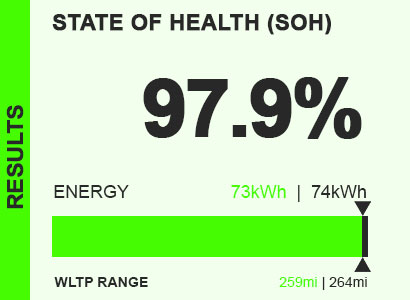
The State of Health, SoH, of an electric vehicle battery is how much of your original battery capacity, 100%, remains. An 80% SoH means your battery holds 80% of the energy it did when it left the factory. A lower SoH translates into reduction in driving range. Most EV manufacturers consider a battery to be at its “End of Life” when it hits 70% SoH. Batteries with a SoH of 84% or less should be considered for trade-ins, incentive program, and other electric battery storage use-cases. Used batteries can be disassembled and then reassembled with other uncompromised cells to perform as stable battery storage devices which demand much lighter loads than electric vehicles require.
How Is SoH Calculated
Every EV has a Battery Management System, or BMS, which monitors the vehicle battery’s SoH. The BMS calculates the SoH by dividing the current usable capacity by the nominal factory capacity and by continuously monitoring cell voltages, charge cycles, internal resistance, and operating temperatures.
What Degrades EV Battery SoH?
All EV batteries degrade over time as a normal condition. However, consistent extreme heat and freezing cold temperatures accelerate capacity loss stressing the chemical makeup of the battery. Additionally, extreme charge levels including charging an electric vehicle battery to 100% or leaving the battery below 20% for several days also speeds up chemical wear. The materials that make up the battery, known as battery chemistry, also affect best EV battery management practices. The popular NMC batteries made of Nickel, Manganese, and Cobalt are popular with manufacturers for their performance, range, and lifespan. These batteries are used in Tesla Long Range and Performance trims, Lucid performance and Gen 1 Rivian R1T and R1S models. These batteries NMC chemistry is good in cold weather, for long range and performance but requires owners to keep the at rest charge, when the vehicle is parked and no charging, to be between 20% and 70% or 80%. Resent studies showed an NMC battery that was kept at 60%, continually used to 50%, and then charged daily back to 60%, lasted more than 400,000 miles. And while this is not a real world use-case, it shows the importance of keeping the cells within the battery pack balanced. To do this, only charge to 100% when you are driving an NMC battery car immediately or very soon after it reaches 100% and only let the battery get below 20% when you are on the way to charging the vehicle back above 20%.
How to Check Your EV's SoH
Unlike State of Charge (SoC)—which simply shows how much charge is left right now—your dashboard rarely displays SoH directly as a simple percentage. Accessing the SoH score for an electric vehicle depends on the make and model of the vehicle. Comprehensive SoH status is not easily accessed by the consumer for most EV makes and models and requires dealer diagnostic equipment or more affordable options like the EV VERIFIED RAPID TESTS.
More from EV Zone:
With help from Geotab and Biologic